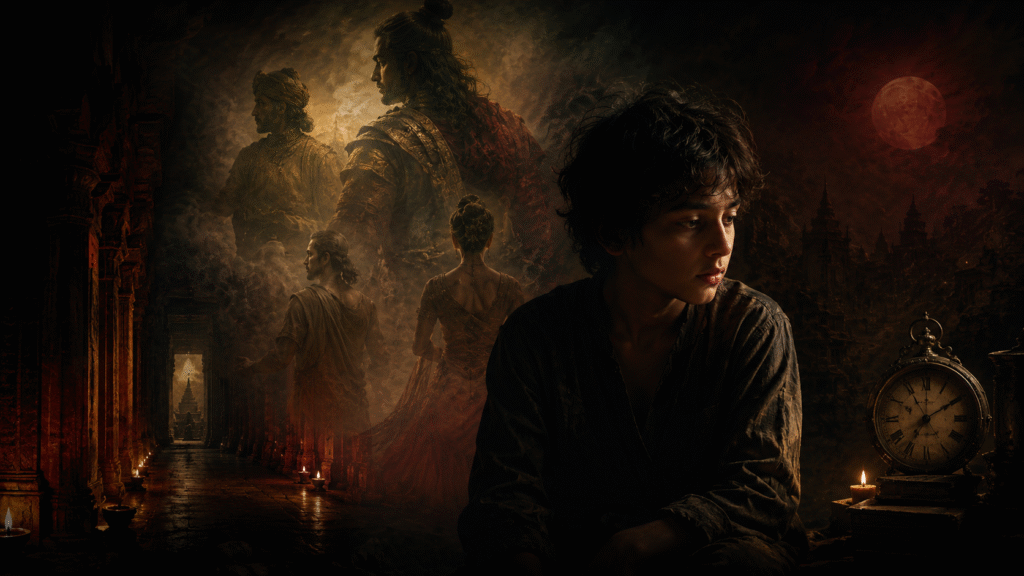
Some memories feel older than the life we are living.
A child describes a house they have never visited. Someone feels overwhelming sadness in a city they have never seen before. A person has a fear, talent, or attraction that seems to come from nowhere. A stranger feels familiar. A place feels like home before we understand why.
For people who believe in reincarnation, these moments are not random.
They may be echoes.
Reincarnation is the idea that consciousness, soul, or some part of the self continues after death and returns in another life. It is one of the oldest spiritual beliefs in human history, appearing in different forms across cultures, religions, and philosophical traditions.
But the most fascinating part of reincarnation is not the belief itself.
It is the stories.
Especially stories of people — often children — who appear to remember lives they never lived.
The Strange Case of Childhood Memories
Many reincarnation stories begin with children.
A child may suddenly talk about “when I was big” or “my other family.” They may describe names, places, jobs, accidents, or relationships that seem far beyond normal imagination.
Parents often dismiss it at first. Children invent stories all the time. They mix dreams, television, overheard conversations, and fantasy. But some cases become harder to ignore when details appear specific.
A child who has never been near the ocean describes drowning.
A child recognizes a town they have never visited.
A child gives a name connected to a person who died before they were born.
A child has strong emotions toward strangers in old photographs.
Skeptics say these stories can be explained by coincidence, suggestion, false memory, or information the child may have heard without remembering.
That is possible.
But for the families involved, the experience can feel much deeper than coincidence.
The child does not speak like they are pretending. They speak like they are remembering.
Why Children?
One reason reincarnation memories are often linked to children is that young children have not yet fully built a stable identity.
They are still forming their sense of self. Their imagination is active, their dreams are vivid, and their connection to the world feels less fixed than it does for adults.
Believers say this is exactly why past-life memories may appear early. The child has not yet fully forgotten.
As the child grows older, the memories often fade. By the age of six, seven, or eight, many children stop talking about them. They become more grounded in this life, this family, this name, this identity.
That fading pattern is one of the reasons people find these stories so interesting.
If children were simply making things up, why do the stories often disappear with age?
Maybe because imagination changes.
Or maybe because the door closes.
Unexplained Fears and Attachments
Not all possible reincarnation memories come as clear stories.
Sometimes they appear as emotions.
A person may have an intense fear of fire, water, heights, enclosed spaces, or certain sounds without any obvious cause. Another person may feel drawn to a country, language, historical period, or culture they have no connection to.
Some people feel grief when hearing music from another era. Others feel comfort in places they should not recognize.
Psychology offers explanations: inherited trauma, subconscious learning, anxiety, early forgotten experiences, family influence, or pattern-making.
But reincarnation believers see another possibility.
Maybe some fears are not born in this life.
Maybe some attachments are not random.
Maybe the soul carries emotional traces even when the mind forgets the story.
A fear of drowning may not prove a past-life death. A love of old cities may not prove a previous existence there. But when the feeling is strong, specific, and persistent, it can make people wonder where it came from.
Talents That Feel Like Remembering
Another mystery is talent.
Some people seem to arrive in life already connected to certain abilities. A child plays music with unusual sensitivity. Someone learns a language quickly. A person feels naturally drawn to art, healing, sailing, architecture, or ancient history.
Of course, talent can be explained by genetics, environment, exposure, practice, and personality.
But some talents feel different to the person experiencing them.
They do not feel like learning.
They feel like remembering.
Musicians sometimes describe touching an instrument for the first time and feeling strangely at home. Artists may feel guided by images they do not understand. People may become obsessed with a craft or subject without knowing why.
This does not prove reincarnation.
But it raises an interesting question:
What if not everything inside us begins at birth?
Déjà Vu and Past-Life Echoes
Déjà vu is often connected to reincarnation.
The feeling of “I have been here before” can be powerful, especially when it happens in an unfamiliar place. A street, building, landscape, or face may trigger a sudden wave of recognition.
Science explains déjà vu as a memory-processing event. The brain mistakenly labels a new moment as familiar.
That explanation is reasonable.
But some déjà vu experiences feel unusually emotional. They come with sadness, fear, longing, or a sense of return.
A person may visit a town for the first time and somehow know where a road leads. Someone may meet a stranger and feel immediate recognition. A house may feel familiar before any logical memory exists.
Maybe déjà vu is only a brain glitch.
Or maybe, sometimes, it is the surface of a deeper memory.
The Problem With Proof
Reincarnation is difficult to prove.
Personal stories are powerful, but they are not the same as scientific evidence. Memories can be wrong. Children can absorb information without adults realizing it. Families can unintentionally lead a child with questions. People can connect details after the fact.
A skeptical approach matters.
But skepticism does not erase the mystery completely.
Some cases contain details that appear unusual. Some stories affect families deeply. Some memories appear before the child has access to the information they describe.
Even if only a small percentage of cases remain unexplained, they keep the question open.
What happens to consciousness after death?
Does memory belong only to the brain?
Or can something survive beyond the body?
Why the Idea Matters
Reincarnation is not only about the past.
It changes how people think about life.
If reincarnation is real, then identity is bigger than one lifetime. The people we meet may not be strangers. Our fears may have deeper roots. Our talents may have history. Our relationships may continue across time.
It also changes how people think about suffering, growth, and purpose.
Maybe life is not a single test, but a long journey.
Maybe lessons repeat until they are understood.
Maybe love, guilt, fear, and desire leave marks that carry forward.
That idea can be comforting.
It can also be unsettling.
Because if we have lived before, we may have forgotten almost everything important.
What If the Memories Are Real?
If reincarnation memories are real, then the world is stranger than it appears.
A child’s story may not be fantasy.
A fear may not be random.
A dream may not be only a dream.
A place may feel familiar because some part of us has already walked there.
But even if reincarnation is not real in the literal sense, these stories still reveal something profound about human consciousness.
We are made of memory, emotion, imagination, instinct, and mystery. Sometimes those layers speak in ways we do not understand.
Maybe reincarnation memories are proof of past lives.
Maybe they are symbols created by the mind.
Maybe they are echoes of family history, collective memory, or something science has not yet explained.
The truth is still unknown.
But the question remains powerful:
Are we new beings moving through life for the first time?
Or are we older than we remember?