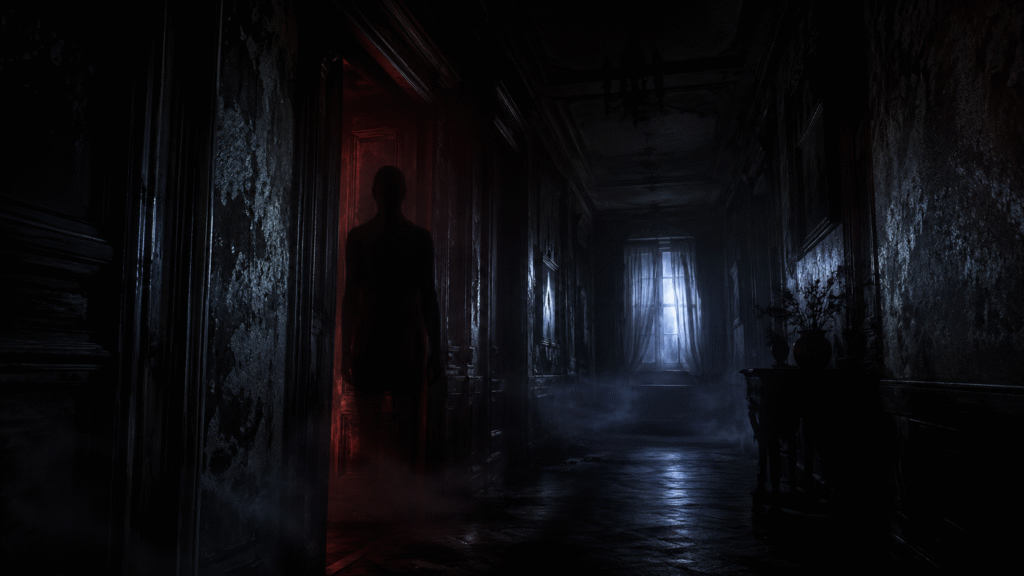
Almost everyone understands the fear of seeing something move in the corner of the eye.
A dark shape in a hallway. A figure near the bed. A human-like shadow standing where no person should be.
For some people, it happens once and is quickly explained away: a coat on a chair, a trick of the light, the mind filling in shapes in darkness. But for others, the experience is much harder to forget.
They do not simply see a shadow.
They see a presence.
Shadow figures are among the most common and disturbing types of paranormal reports. People describe them as dark, human-shaped forms, often silent, sometimes tall, sometimes fast-moving, sometimes wearing what looks like a hat or long coat. They are usually seen at night, in bedrooms, hallways, doorways, staircases, or at the edge of sleep.
Are shadow figures ghosts? Spirits? Visitors from another dimension? A psychological phenomenon? Or something created by fear, stress, and darkness?
The answer depends on who you ask.
But the stories keep coming.
What Are Shadow Figures?
Shadow figures are usually described as black or dark gray human-like shapes.
They often have no detailed face, no visible clothing, and no clear physical features. Some witnesses say they are flat like a shadow on a wall. Others say they appear three-dimensional, as if a person made of darkness is standing in the room.
The most common reports include:
A figure standing at the foot of the bed.
A dark shape moving quickly across a hallway.
A tall shadow watching from a corner.
A human-like form disappearing when noticed.
A presence felt before it is seen.
Many people say the experience comes with a strong feeling of being watched.
That feeling may be the most frightening part.
A shadow on its own can be dismissed. But a shadow that seems aware of you becomes something else entirely.
The Sleep Paralysis Connection
One of the strongest scientific explanations for shadow figures is sleep paralysis.
Sleep paralysis happens when the mind wakes up while the body remains temporarily unable to move. It can occur while falling asleep or waking up. During this state, people may experience pressure on the chest, difficulty breathing, fear, sounds, footsteps, whispers, or visual hallucinations.
Many sleep paralysis reports include a figure in the room.
Sometimes it stands in the corner. Sometimes it approaches the bed. Sometimes it feels like it is sitting on the person’s chest.
This phenomenon has been reported across cultures for centuries. Different traditions explain it in different ways: demons, spirits, witches, night visitors, or dark entities.
Modern science explains it through REM sleep, brain activity, and the body’s natural paralysis during dreaming. The fear feels real because the brain is partly still in a dream state while the person is awake enough to perceive the room.
This explanation makes sense for many shadow figure encounters.
But it does not explain all of them.
Some people report seeing shadow figures while fully awake, standing, walking, or speaking with others. Some cases involve multiple witnesses. Some happen in daylight. Some are seen by children, adults, and even pets reacting at the same time.
That is where the mystery remains.
The Hat Man
One of the most famous shadow figure reports is known as the Hat Man.
Witnesses describe a tall dark figure wearing a wide-brimmed hat. He is usually seen standing still, watching silently. Unlike random shadows, the Hat Man appears in surprisingly similar descriptions from people who have never met.
Some see him during sleep paralysis. Others claim to have seen him while completely awake.
Reports often include intense fear, but not always. Some people say the figure feels threatening. Others say it feels neutral, like an observer.
Why do so many people describe a shadow figure with a hat?
Skeptics may say the image is culturally familiar: old coats, noir films, silhouettes, childhood fears, or the brain using known shapes to create a figure in darkness.
Believers may say the repeated details suggest something more.
A recurring entity.
A type of spirit.
A watcher.
A visitor that appears in the same form to different people.
There is no proof either way. But the consistency of the reports is one reason the Hat Man remains one of the most unsettling paranormal legends online.
Why the Brain Sees Figures in Darkness
The human brain is designed to recognize patterns.
Especially faces and bodies.
This ability helped our ancestors survive. If something in the dark looked like a person or animal, it was safer to notice it quickly than to ignore it.
But the same survival system can also create false alarms.
In low light, the brain has less information. Shadows become shapes. Clothes become bodies. Furniture becomes movement. A reflection becomes a face. A moment of fear becomes a presence.
This is called pareidolia — the tendency to perceive meaningful shapes in random patterns.
It explains many strange sightings.
But again, it does not explain why some experiences feel so vivid, intelligent, and personal.
People who report shadow figures often say:
“I know what a shadow looks like. This was different.”
That sentence appears again and again in personal accounts.
Whether they are right or not, the emotional certainty is powerful.
Are Shadow Figures Paranormal?
Paranormal believers offer several theories.
Some believe shadow figures are ghosts or spirits that do not fully manifest. Others believe they are negative entities, attracted to fear, grief, trauma, or emotionally heavy places.
Another theory suggests they are interdimensional beings — entities that exist near our reality but only sometimes become visible. According to this idea, shadow figures are not dead people, but something stranger.
Some connect them to time slips, portals, occult activity, or locations with repeated unexplained events.
These theories are impossible to confirm with ordinary evidence. But they continue because many witnesses feel that their encounter had intention behind it.
A normal shadow does not watch you.
A normal shadow does not move against the light.
A normal shadow does not make a dog growl at an empty corner.
That is why many people reject simple explanations, even when they understand them.
Why People Fear Them So Much
Shadow figures are frightening because they combine several primal fears:
Darkness.
Human shape.
Silence.
Being watched.
The unknown.
A monster with details can sometimes be understood. A face, a body, a sound — these give the mind something to process.
But a shadow figure gives almost nothing.
It is familiar enough to seem human, but empty enough to feel wrong.
That is what makes it so disturbing.
It is not a clear threat. It is a question standing in the room.
What To Do If You See One
If someone sees a shadow figure, the first step should be calm observation.
Look for ordinary explanations:
Is there a light source creating the shape?
Could it be clothing, furniture, curtains, or a reflection?
Were you falling asleep or waking up?
Were you stressed, exhausted, or sleep deprived?
Did anyone else see it?
Did pets react?
Has it happened more than once?
Writing down the time, place, lighting, emotional state, and details can help separate patterns from fear.
Most experiences will likely have ordinary causes.
But if something repeats in the same place, or multiple people notice it independently, the story becomes harder to dismiss.
The Mystery Remains
Shadow figures live in the space between psychology and the paranormal.
Science can explain many of them. Sleep paralysis, low light, stress, memory, fear, and pattern recognition are real. The brain can create terrifying experiences that feel completely external.
But the mystery does not disappear entirely.
Not every witness was asleep.
Not every sighting happened in darkness.
Not every case involved only one person.
Not every story feels like a mistake.
Maybe shadow figures are nothing more than the mind projecting fear into darkness.
Maybe they are memories, dreams, or old survival instincts.
Maybe they are spirits.
Maybe they are something that has learned to stand just close enough to be seen, but never clearly enough to be proven.
Whatever they are, one thing is certain:
When someone says they saw a shadow figure, they usually do not forget it.
Because the scariest part is not always what they saw.
It is the feeling that it saw them too.