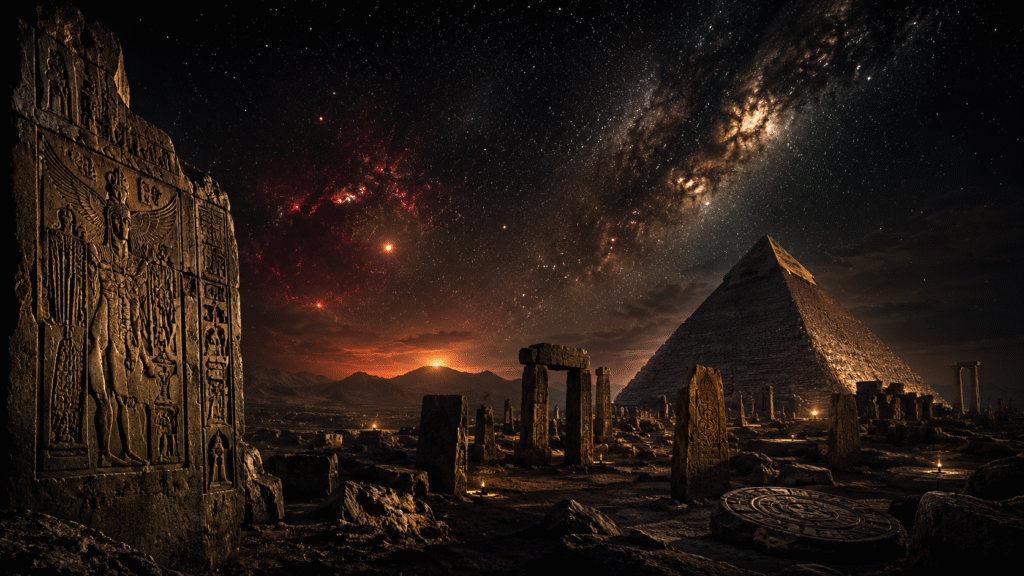
Human history is full of ruins that feel larger than explanation.
Pyramids rising from desert sand. Megalithic stones aligned with stars. Temples carved into mountains. Ancient myths that speak of beings descending from the sky. Cities swallowed by jungle, oceans, earthquakes, and time.
Every generation believes it understands the past better than the one before it.
But the deeper we look, the more questions appear.
How did ancient people move massive stones with such precision? Why do distant cultures share similar stories of sky beings, floods, giants, star knowledge, and lost golden ages? Why do some ancient monuments seem aligned with celestial events? And why does so much of human history feel incomplete?
Mainstream history explains many things through engineering, religion, politics, agriculture, astronomy, and human creativity.
But mystery culture asks a different question:
What if we have forgotten more than we know?
The Power of Ancient Monuments
Ancient monuments have always inspired wonder.
A pyramid is not just a building. A stone circle is not just a collection of rocks. A temple is not just architecture. These places feel like messages sent across time.
They were built by people who lived in worlds very different from ours, yet they often reveal advanced planning, mathematical awareness, astronomical observation, and deep symbolic meaning.
The mystery is not always that ancient people “could not have built them.”
That idea can be unfair. Ancient civilizations were intelligent, skilled, organized, and capable of extraordinary achievements.
The real mystery is why so many monuments seem designed to connect Earth with the sky.
Stars, solstices, equinoxes, lunar cycles, sacred directions, and cosmic patterns appear again and again.
Maybe ancient people simply watched the sky more closely than we do.
Or maybe they believed the sky was not empty.
Stories of Beings From Above
Across many cultures, myths speak of beings coming from the heavens.
Gods descend from the sky. Teachers arrive from the stars. Fire comes from above. Knowledge is given to humanity by powerful visitors. Civilizations begin after contact with divine or semi-divine figures.
In Egypt, Mesopotamia, India, Mesoamerica, Africa, and other regions, ancient stories often connect human destiny with celestial beings.
Of course, mythology should not be read too literally. Ancient people used symbolic language. “Sky gods” may represent storms, planets, kingship, spiritual forces, or religious imagination.
But the repetition is fascinating.
Why did so many cultures place the source of knowledge above them?
Was it simply because the sky felt sacred?
Or did ancient people preserve memories of encounters they could only describe through myth?
This question is at the center of ancient astronaut theories — the idea that non-human intelligence may have influenced early human civilization.
It is controversial.
But it remains popular because ancient myths often sound strangely similar to modern contact stories.
The Anunnaki Question
Few ancient mystery topics are as famous online as the Anunnaki.
In Mesopotamian mythology, the Anunnaki were powerful deities associated with the heavens, earth, and underworld. In modern alternative theories, they are often reinterpreted as advanced beings who came from another world and influenced humanity.
Some versions of the theory claim they created or modified humans. Others connect them to mining, kingship, ancient knowledge, or hidden bloodlines.
Mainstream scholars do not support these modern interpretations as historical fact. The Anunnaki belong to ancient religious and mythological systems, not confirmed extraterrestrial records.
But the reason the theory continues is simple:
It offers a dramatic explanation for human origins.
Instead of humanity slowly developing through natural processes, the theory imagines intervention. A missing chapter. A hidden creator. A cosmic influence behind civilization.
Whether taken literally or symbolically, the Anunnaki story touches a deep question:
Did humans become what we are entirely on our own?
Or was something else involved?
Lost Civilizations
Another powerful mystery is the idea of lost civilizations.
History shows that civilizations can disappear. Cities are abandoned. Empires collapse. Knowledge is lost. Libraries burn. Sea levels rise. Earthquakes destroy settlements. Forests swallow roads and temples.
So the idea of forgotten civilizations is not impossible.
The question is how advanced they were.
Some theories suggest there may have been highly developed societies before the earliest known civilizations. These societies may have been destroyed by floods, climate events, war, or cosmic impacts, leaving only fragments behind.
This idea connects to legends of Atlantis, Lemuria, pre-flood civilizations, and ancient global cultures.
Skeptics argue that extraordinary claims need strong evidence. Ruins, tools, writing, settlements, and datable remains matter.
That is fair.
But believers point to myths of great floods, sudden destruction, and knowledge passed down from earlier ages. They argue that human memory may preserve traces of real events, even when history loses the details.
Maybe lost civilizations were not super-advanced in the way modern fiction imagines.
Maybe they did not have lasers, flying machines, or global technology.
But perhaps they understood things about astronomy, stonework, navigation, healing, or consciousness that we have underestimated.
Ancient Astronomy
One of the strongest bridges between history and mystery is ancient astronomy.
Many ancient cultures watched the sky with incredible patience. They tracked seasons, eclipses, planetary movements, star cycles, and celestial alignments. Their monuments often reflect this relationship.
To modern people, astronomy is science.
To ancient people, the sky was also spiritual, agricultural, political, and mythological. It told them when to plant, when to harvest, when to gather, when to perform rituals, and how to understand their place in the universe.
But some alignments still feel astonishing.
How did ancient builders achieve such precision?
How did they preserve astronomical knowledge across generations?
Why did they encode cosmic patterns into stone?
The simple answer may be observation, tradition, and long-term dedication.
The mysterious answer is that they may have inherited knowledge from an older source.
Maybe both can be true.
Megaliths and Impossible Stones
Massive stones are one of the biggest reasons people question ancient history.
Some ancient sites contain blocks so large that even modern observers wonder how they were cut, transported, and placed. The mystery becomes stronger when the stones fit together with impressive precision or appear in remote locations.
Mainstream explanations involve human labor, ramps, rollers, levers, sledges, water, planning, and time.
These explanations are often more realistic than they first sound. Ancient people did not need modern machines to achieve greatness.
But the emotional reaction remains.
When you stand before a stone weighing hundreds of tons, theory feels smaller than reality.
The mind naturally asks:
Why would they do this?
How did they organize so many people?
What knowledge have we lost?
Were these structures more than monuments?
That last question is important.
Maybe some ancient structures were not only symbolic. Maybe they were designed for sound, energy, ritual, astronomy, memory, or altered states of consciousness.
We may understand the stones as objects.
But perhaps we do not fully understand their purpose.
Myths as Memory
Modern people often separate myth and history.
History is fact.
Myth is story.
But ancient cultures may not have seen the division so clearly.
Myths can preserve memory. A flood story may remember a real flood. A dragon may symbolize a comet, volcano, or enemy. A sky god may represent a planet, ancestor, ruler, or something unknown.
Over time, real events become stories. Stories become symbols. Symbols become religion. Religion becomes myth.
By the time modern people read them, the original event may be buried under layers of meaning.
This does not mean every myth is literally true.
But it does mean myths should not be dismissed as meaningless.
They may be coded memories.
Not perfect records.
But echoes.
Ancient Aliens or Ancient Humans?
One of the biggest debates in mystery culture is whether ancient wonders point to aliens or to forgotten human ability.
Some people argue that ancient monuments are too advanced to be explained by known history, so they suggest extraterrestrial help.
Others argue that this view underestimates human intelligence and creativity. Ancient people were capable of astonishing work without outside intervention.
The responsible view should be careful.
We should not remove credit from ancient civilizations by assuming they needed aliens.
But we also should not pretend every question is fully answered just because a basic explanation exists.
The best mysteries are not built on disrespect.
They are built on curiosity.
Maybe ancient humans were more advanced than we think.
Maybe they inherited older knowledge.
Maybe they interacted with phenomena we do not understand.
Maybe “alien” is not the right word at all.
Maybe the unknown is not outside human history.
Maybe it is hidden inside it.
Why These Theories Survive
Ancient civilization theories survive because they speak to something deep.
People sense that the modern world is disconnected from the past. We live with technology, screens, schedules, and information, but many ancient structures feel more permanent than anything we build today.
They make us feel small.
They remind us that people before us looked at the same stars, feared death, searched for meaning, built sacred places, and asked where we came from.
The theories may not all be true.
But the hunger behind them is real.
We want to know if history has missing pages.
We want to know if humanity was guided, interrupted, reset, or reborn.
We want to know if the ruins are only ruins — or warnings, memories, and messages.
The Unknown Beneath History
Ancient civilizations do not need aliens to be mysterious.
They already are.
The mystery is in their silence.
Their scale.
Their alignments.
Their myths.
Their lost languages.
Their buried cities.
Their forgotten rituals.
Their relationship with the sky.
Maybe the truth is less dramatic than the theories.
Maybe there were no star visitors, no hidden technology, no secret global civilization.
Maybe there were only humans — brilliant, spiritual, organized, patient humans — doing things we have forgotten how to understand.
Or maybe the past is stranger than the official story allows.
Maybe the myths preserve something real.
Maybe the stones were placed for reasons we have not rediscovered.
Maybe human history is not a straight line from primitive to modern, but a broken circle of rise, collapse, memory, and forgetting.
The ruins do not answer.
They wait.
And that may be why we keep returning to them.
Because somewhere inside ancient stone, old myths, and forgotten stars, we feel there is still a truth we have not fully found.