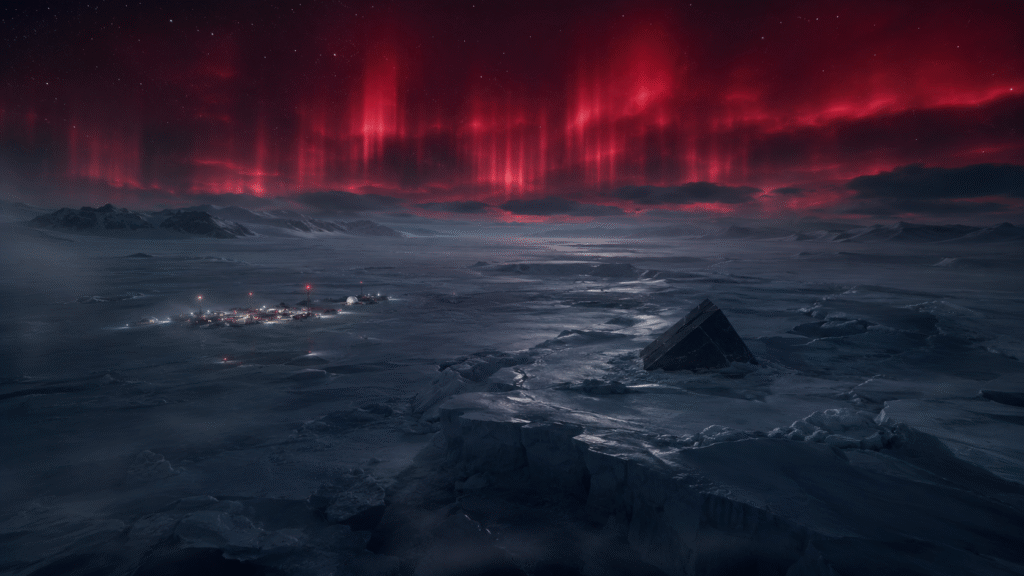
Antarctica is one of the most mysterious places on Earth.
It is larger than most people imagine, covered almost entirely in ice, surrounded by dangerous seas, and visited by only a small number of people compared to the rest of the planet. It has no permanent civilian population, no ordinary cities, and no casual road trips. Most of us will never go there.
That distance creates mystery.
And mystery creates theories.
For decades, Antarctica has been connected to some of the strangest conspiracy claims in the world: secret military bases, hidden entrances beneath the ice, lost civilizations, ancient maps, alien technology, restricted zones, and even theories about the true shape of Earth.
Some of these ideas are clearly speculative. Some are based on misunderstandings. Some come from old myths, wartime rumors, or internet storytelling. But the reason Antarctica attracts so many theories is not difficult to understand.
It is remote.
It is extreme.
It is difficult to access.
And most people only know it through maps, satellite images, documentaries, and official explanations.
When a place feels unreachable, people begin to wonder what might be hidden there.
The Power of Isolation
Antarctica feels separate from the rest of the world.
Even on a map, it looks different. A massive white landmass at the bottom of the planet, almost silent, almost empty, almost unreal.
Unlike other continents, Antarctica is not associated with normal human life. There are no major cities, no ancient ruins open to tourists, no highways, no farms, no regular neighborhoods, and no long cultural history visible to the public in the same way as Europe, Asia, Africa, or the Americas.
That emptiness gives the imagination space to grow.
If a place is empty, people ask why.
If a place is difficult to reach, people ask what is being protected.
If a place is controlled by treaties, permits, research stations, and official routes, people ask who really controls it.
Most of the actual reasons are practical: dangerous weather, environmental protection, logistics, safety, and scientific regulation.
But for conspiracy culture, practical explanations rarely feel satisfying.
The more inaccessible something is, the easier it becomes to imagine secrets.
Restricted Access and the Feeling of Control
One major reason Antarctica fuels conspiracy theories is that most people cannot simply go there freely.
Travel is possible, but it is expensive, limited, and usually organized through controlled routes. Scientific work requires planning, permits, transport, funding, and extreme safety measures.
To researchers and expedition teams, this makes sense. Antarctica is dangerous and fragile. A small mistake can become life-threatening. Human activity can damage the environment. Rescue operations are difficult.
But to people already suspicious of governments or global institutions, restrictions can feel like evidence.
They ask:
Why can’t anyone just explore it?
Why are certain areas not accessible?
Why do so many countries cooperate there?
Why is the continent treated differently from the rest of the world?
Again, there are normal answers.
But Antarctica’s unusual legal and political status makes it feel like a place under special control. That feeling is enough to keep theories alive.
Secret Bases Beneath the Ice
One of the most common Antarctica theories involves secret bases.
Some versions claim there are hidden military facilities beneath the ice. Others imagine underground cities, alien installations, ancient technology, or abandoned wartime projects.
The idea became especially popular because Antarctica naturally feels like the perfect hiding place.
If someone wanted to build something away from public attention, where would they put it?
A frozen continent at the edge of the world sounds almost too perfect.
There are real research stations in Antarctica, and some are isolated, high-tech, and difficult to reach. For most people, images of these facilities already look unusual. They sit in endless white landscapes, surrounded by ice, machines, antennas, and equipment.
It does not take much imagination to turn a research station into something more mysterious.
A satellite dome becomes a communication device.
A restricted research area becomes a hidden entrance.
A scientific drilling project becomes a search for ancient secrets.
The reality may be ordinary science.
But the visual language of Antarctica makes everything look like classified science fiction.
Lost Civilizations and Ancient Maps
Another powerful theory is that Antarctica may once have been home to an ancient civilization.
This idea often connects to old maps, especially maps that some people believe show Antarctica before it was covered in ice. The theory suggests that an advanced civilization may have mapped the continent thousands of years ago, before history as we know it.
Mainstream historians and geographers do not accept most of these claims in the way conspiracy communities present them. Old maps are often misread, symbolic, inaccurate, or based on limited information.
But the idea remains popular because it offers a dramatic possibility:
What if human history is much older than we think?
What if Antarctica hides ruins under miles of ice?
What if an advanced civilization existed before recorded history and disappeared after a global catastrophe?
This connects Antarctica to other popular mystery topics: Atlantis, ancient aliens, lost technologies, pre-flood civilizations, and hidden human origins.
The ice becomes more than ice.
It becomes a locked archive.
A frozen memory of a world before ours.
The Nazi Antarctica Rumors
Another long-running thread involves rumors about Nazi activity in Antarctica.
There were historical German expeditions to the region before World War II, and after the war, rumors grew into stories about hidden bases, secret escapes, advanced technology, and mysterious operations beneath the ice.
Most extreme versions of these claims are not supported by credible evidence. But the combination of Antarctica, World War II secrecy, advanced weapons programs, and missing information created the perfect environment for legends.
The story has all the ingredients conspiracy culture loves:
A remote location.
A defeated regime.
Secret technology.
Hidden survivors.
Military silence.
A frozen continent few people can personally verify.
Even when evidence is weak, the atmosphere of the story is powerful.
Antarctica becomes a stage where history and myth blur together.
Alien Theories and the Ice
Antarctica also attracts alien theories.
Some people believe objects have been discovered beneath the ice. Others claim strange structures appear in satellite images. Some connect the continent to UFO sightings, ancient alien bases, or non-human technology hidden from the public.
The appeal is obvious.
If extraterrestrial visitors came to Earth and wanted to hide something, Antarctica would be a strong candidate in the imagination of mystery culture. It is remote, frozen, difficult to search, and full of areas most people will never see up close.
Satellite images add fuel to this.
A strange shape in the ice can become a crashed craft.
A shadow can become an entrance.
A natural formation can become a structure.
A blurred area can become a cover-up.
Most of the time, these images have ordinary explanations: ice movement, rock formations, lighting, compression artifacts, shadows, or natural geography.
But the internet is very good at turning unclear images into mysteries.
And Antarctica provides endless unclear images.
Flat Earth and Antarctica
One of the most famous modern conspiracy connections is between Antarctica and Flat Earth theories.
In many Flat Earth narratives, Antarctica is not a continent at the bottom of a globe, but an ice wall surrounding the world. According to these claims, people are prevented from exploring freely because they might discover the “edge” or the true structure of Earth.
Scientific evidence overwhelmingly supports Earth as a sphere, and Flat Earth claims do not stand up to physics, navigation, astronomy, satellite communication, or global travel.
But the theory continues because Antarctica plays a symbolic role.
It becomes the border.
The forbidden edge.
The place where the official world map supposedly breaks down.
For people who already distrust institutions, Antarctica feels like the perfect missing piece in a larger worldview. It is distant enough that most people cannot personally test every claim. It is regulated enough to feel suspicious. It is visually strange enough to support imagination.
That does not make the theory true.
But it explains why Antarctica is central to it.
The Mystery of What We Cannot See
At the heart of Antarctica conspiracy theories is one simple problem:
We cannot see everything.
There are places beneath the ice that humans have not fully explored. There are lakes sealed under glaciers. There are mountains buried below ice sheets. There are regions where satellite images are difficult to interpret. There are scientific discoveries most people only hear about through official summaries.
This does not mean there is a cover-up.
But it does mean Antarctica still contains real unknowns.
That is important.
Not every mystery is a conspiracy. Some mysteries are simply the result of nature being vast, extreme, and difficult to study.
The problem begins when people turn every unknown into proof of a hidden truth.
A gap in knowledge becomes evidence.
A blurred image becomes a secret.
A research project becomes a cover story.
A restricted area becomes a forbidden kingdom.
The unknown is powerful because it can hold almost any idea we place inside it.
Why Antarctica Feels Different
Other remote places inspire theories too: deserts, oceans, deep forests, mountain ranges, caves, and military zones.
But Antarctica feels different because it is both real and almost mythological.
It is on every map, yet outside normal life.
It is part of Earth, yet feels alien.
It is studied by scientists, yet still full of unknowns.
It is visible from satellites, yet still emotionally unreachable.
That combination makes it perfect for modern mystery culture.
Antarctica is not just a place.
It is a symbol.
A symbol of hidden history, forbidden knowledge, global secrecy, and the possibility that the world still contains places we do not fully understand.
The Responsible Way to Explore the Theories
It is possible to be curious about Antarctica theories without believing every claim.
That balance matters.
We can ask questions without turning speculation into fact. We can enjoy mystery without spreading harmful misinformation. We can explore strange claims while still respecting science, history, and evidence.
The best approach is not blind belief or automatic dismissal.
It is careful curiosity.
Ask:
Where did this claim come from?
Is there evidence?
Could there be a simpler explanation?
Who benefits from making the claim sound dramatic?
Does the theory rely on fear, secrecy, or distrust?
What do actual researchers say?
Mystery should open the mind, not replace it.
Why the Theories Will Not Disappear
Antarctica conspiracy theories will probably never go away.
As long as the continent remains remote, dangerous, regulated, and visually mysterious, people will imagine what might be hidden there.
Some will see secret bases.
Some will see lost civilizations.
Some will see alien technology.
Some will see the edge of the world.
Some will simply see a place that reminds us how much of Earth remains beyond ordinary human experience.
Maybe Antarctica hides nothing more than ice, rock, weather, and scientific discovery.
Maybe that is already mysterious enough.
Or maybe, beneath the silence and snow, there are stories we have not uncovered yet.
That is why Antarctica continues to fascinate us.
Not because every theory is true.
But because the continent itself feels like a question.
A white, frozen question at the edge of the world.